Dr. Vladimír Tkáč1
Talk: "Chemically tuned thermal conductivity in binary (ZnO)x(P2O5)1−x glasses"
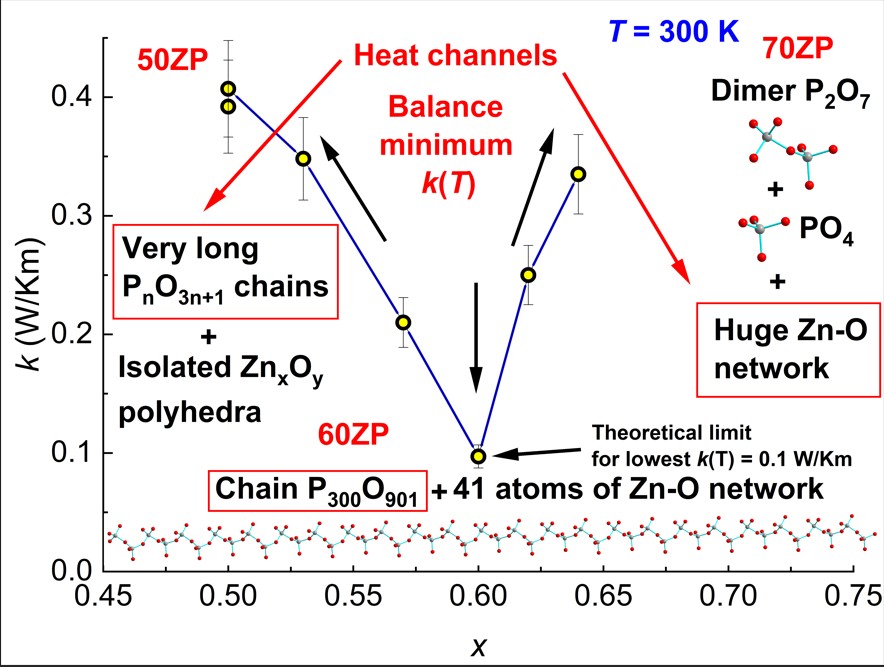
Understanding the mechanisms governing ultra-low and ultra-high thermal conductivity is critical for the design of functional materials. In zinc phosphate glasses, (ZnO)x(P2O5)1-x, the absolute thermal conductivity is strongly governed by the interplay between polymer-like phosphate structures and the zinc oxide network [1]. At the stoichiometric value of x = 0.6, where the network components reach a structural balance and minimal polymer-like/network sizes within the glassy matrix, the thermal conductivity at 300 K drops to approximately 0.1 W K-1 m-1, approaching the theoretical lower limit for solids [2]. The network architecture can be readily tuned across a broad composition range by adjusting the ZnO molar fraction. Moreover, shifting the composition by 10 mol% below or 4 mol% above x = 0.6 causes a fourfold increase in thermal conductivity to ~0.4 W K-1 m-1.
Low-temperature measurements of the specific heat Cp and thermal conductivity κ(T) revealed the universal anomalous behavior characteristic of glasses: a boson peak (BP) in Cp and a plateau in κ(T). The shape of the BP is well described by the corresponding scaling laws, while its position shifts linearly to higher temperatures with increasing x. Furthermore, low-temperature thermal transport data show that propagons are the dominant heat carriers at the lowest temperatures.
The mean free path of phonons at the lowest temperatures for the x ≈ 0.60 sample is comparable to the characteristic length scale of the short phosphate structural units, confirming the polymer-like character of these glasses. Analysis of κ(T) shows that, at room temperature, diffusons contribute roughly twice as much to κ(300 K) as propagons [3,4].
- [1] V. Tkáč, P. Baloh, A. I. Krivchikov, D. Szewczyk, R. Tarasenko, V. Stadnyk, S. Vorobiov, M. Orendáč, A. Orendáčová, J. Holubová, E. Černošková, Z.Černošek, A. Feher, E. Čižmár, J. Mater. Chem. A. 14 (2026) 40438.
- [2] Y. Xia, D. Gaines, J. He, K. Pal, Z. Li, M. G. Kanatzidis, V. Ozoliņš, C. Wolverton, Proc. Natl. Acad. Sci. U. S. A. 120 (2023) e2302541120.
- [3] M. Simoncelli, N. Marzari and F. Mauri, Nat. Phys, 15 (2019) 809.
- [4] A. I. Krivchikov, O. A. Korolyuk, Low Temp. Phys. 50 (2024) 328
Acknowledgements: The work was supported by the project APVV-22-0172.