Prof. Walter Schirmacher1,2
Talk: "Internal Stresses as Origin of the Anomalous Low-Temperature Specific Heat in Glasses"
2Center for Life Nano Science @Sapienza, Istituto Italiano di Tecnologia, 291 Viale Regina Elena, I-00161 Roma, Italy
3Dipartimento di Fisica, Sapienza Università di Roma, Piazzale Aldo Moro 2, 00185 Rome, Italy
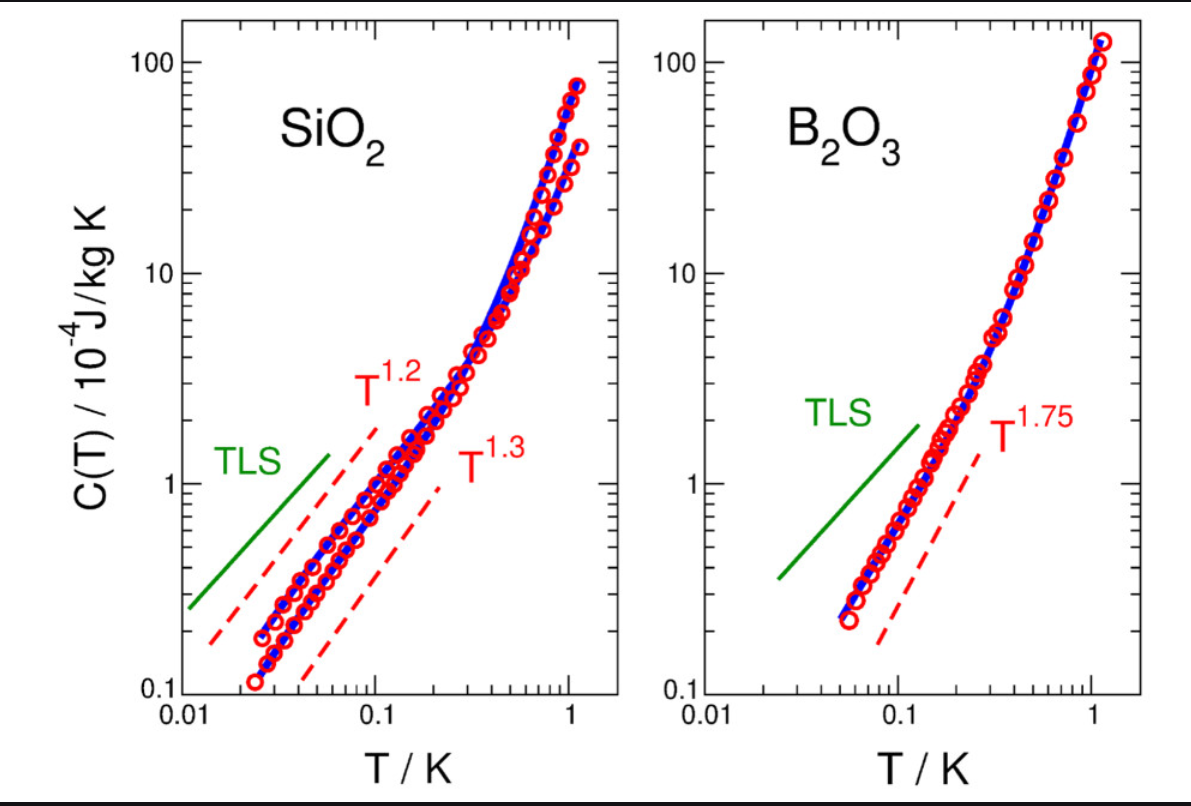
Figure 1: Specific heat data of B2O3 and SiO2 [3] (red circles) together with the prediction of our theory (blue lines). The green lines, denoted TLS, represent the linear temperature dependence predicted by the tunneling model. The dashed red lines are guides to the eye.
We apply a recently developed theory of the nonphononic vibrational density of states (DOS) in glasses [1] to investigate the impact of local frozen-in stresses on the low-temperature specific heat [2]. In the talk we derive this generalized elasticity theory, which includes spatially fluctuating elastic constants and frozen-in stresses by starting from the harmonic part of a potential energy, composed by pairwise potentials. Using this harmonic description we show that the hybridization of the local nonphononic vibrational excitations with the waves leads to a low-frequency DOS, in excess to the Debye one, which varies linearly with frequency up to a certain crossover frequency, and then becomes constant. The actual value of the crossover depends of the ratio between the local stresses and the shear modulus. This excess DOS leads to a variation of the specific heat on temperature as Tx with an apparent exponent x, which is between one and two, as observed experimentally. The traditional explanation of the low-temperature variation of the specific heat in terms of a two-state tunneling model gives a linear T dependence.
- [1] W. Schirmacher, M. Paoluzzi, F. C. Mocanu, D. Khomenko, G. Szamel, F. Zamponi, and G. Ruocco, Nat. Commun. 15, 3107 (2024).
- [2] W. Schirmacher, G. Ruocco, Phys. Rev. Lett. 135, 126102 (2025).
- [3] J. C. Lasjaunias et al., Sol. St. Comm. 14, 957 (1974).