Prof. Iván Santamaría-Holek1
Talk: "From Tunneling States to the Boson Peak: An Interacting Two-Level-System Framework for Glasses"
2Departament de Física de la Matèria Condensada, Facultat de Física, Universitat de Barcelona, Martí i Franquès 1, 08028 Barcelona, Spain
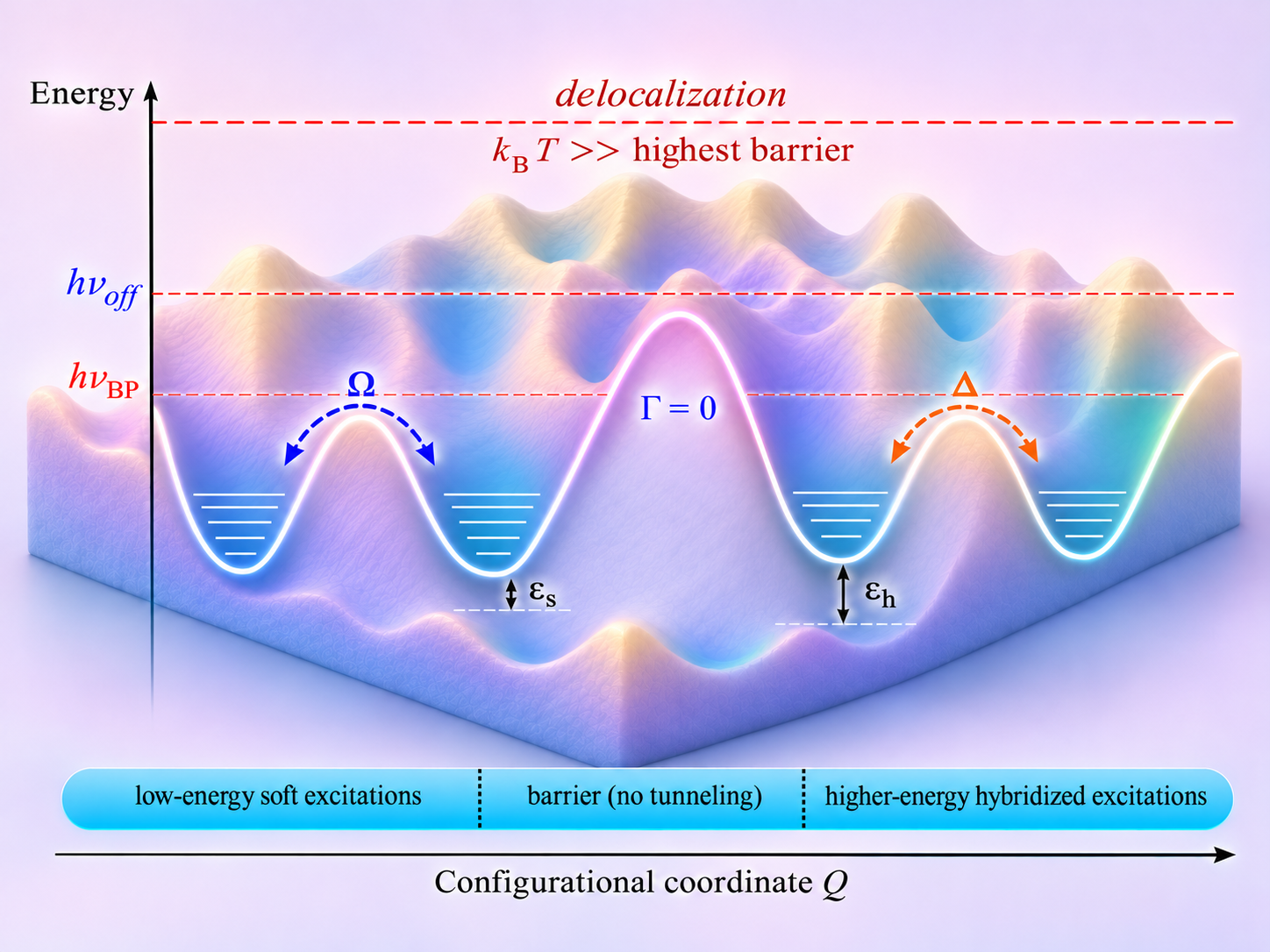
Figure 1: Schematic illustration of a multi-well configurational energy landscape in a disordered system and the evolution of localized collective excitations.
Amorphous solids exhibit low-temperature anomalies that deviate markedly from the Debye behavior of crystals. At ultralow temperatures these anomalies are commonly described in terms of tunneling two-level systems, whereas at higher temperatures glasses display the boson peak, seen as an excess in the reduced vibrational density of states or a maximum in Cp/T3. In this talk we present a unified equilibrium thermodynamic description of both regimes based on an interacting two-level-system (ITLS) framework.
The model uses a coarse-grained three-level Hamiltonian to represent two classes of excitations generated by structural disorder: localized tunneling or soft excitations at low energy, and higher-energy excitations produced by their coupling with elastic vibrations. From the corresponding partition function we derive the specific heat and an effective thermodynamic spectral density that describes the temperature-dependent redistribution of spectral weight between localized and progressively hybridized excitations.
A finite vibrational coherence length introduces an effective cutoff frequency νoff that delimits the thermodynamically active spectral window. Within this picture, the thermodynamic signature traditionally associated with the boson peak is resolved into a low-energy soft contribution, which already develops a boson-peak-like maximum, and a higher-energy hybridized contribution, which is needed to reproduce the complete experimental peak. Fits to specific-heat data for several glass-forming systems reproduce the observed behavior from the tunneling regime up to the boson-peak range and yield νoff values comparable to reported Ioffe–Regel crossover frequencies. These results provide a unified link between tunneling excitations, the progressive loss of vibrational coherence, and the boson peak in disordered solids.
Acknowledgements: A.P.-M. acknowledges financial support from Ministerio de Ciencia, Innovación y Universidades MCIU/AEI/FEDER under Grant Agreement No. PID2024-156516NB-I00 AEI/FEDER-EU. I.S.H. acknowledges the Faculty of Sciences-UMDI-J for support through Grant No. 115377.