Prof. Valentina Giordano1
Talk: "Glass-like phonon dynamics and thermal transport in a GeTe nanocomposite"
2Institut NEEL, CNRS, Université Grenoble Alpes, 25 avenue des Martyrs, F-38042 Grenoble
3Université Grenoble Alpes, CEA, LETI, 38000, Grenoble, France
4Université Grenoble Alpes, CNRS, Grenoble INP, LMGP, Grenoble F-38000, France 5FNRS and CESAM, Université de Liège, 4000 Sart-Tilman, Belgique
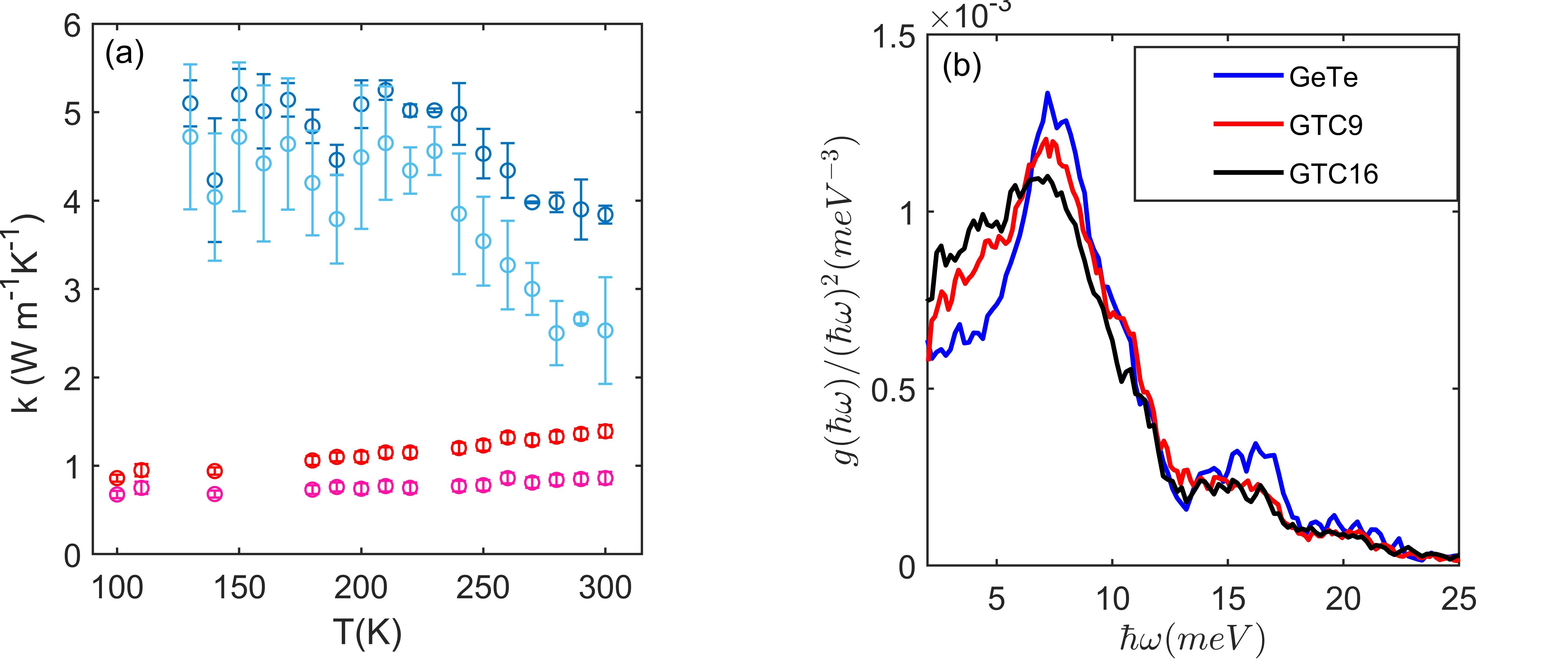
Figure 1: (a) total and lattice thermal conductivity of a GeTe film (blue/light blue) and of the nanocomposite GeTe-C with 9% carbon atomic content (GTC9, red/magenta). (b) reduced phonon density of states for GeTe, GTC9 and a nanocomposite with 16% carbon atomic content (GTC16).
With advances in nanoelectronics, and the need of novel and more efficient energy harvesting solutions, thermal management has arisen as one of the most urgent challenges. To reduce heat dissipation or improve the thermoelectric efficiency, the ultimate goal is a material with a glass-like thermal conductivity but still good electronic properties, for which nanostructuration is one of the most promising strategies, as nanoscale interfaces are expected to scatter the lattice vibrations.
In this work, we report the experimental evidence of glass-like phonon dynamics and thermal conductivity in a nanocomposite made of GeTe and amorphous carbon, of interest for microelectronics, and specifically phase change memories. We show that, the total thermal conductivity is reduced by a factor between 6 and 3 with respect to pure GeTe, due to the reduction of both electronic and phononic contributions. This latter, like in glasses, is small and weakly increasing with temperature between 100 K and 300 K, reaching a value of 0.86 Wm-1K-1 at room temperature. A thorough investigation of the nanocomposite's phonon dynamics reveals the appearance of an excess intensity in the low energy vibrational density of states, reminiscent of the Boson peak in glasses. These features can be understood in terms of an enhanced phonon scattering at the interfaces, due to the presence of elastic heterogeneities, at wavelengths in the 2-20 nm range. Our findings confirm recent simulations on crystalline/amorphous nanocomposites, and suggest a parallelism between glasses and nanocomposites, due to the presence in both of elastic heterogeneities. This will open new perspectives in phonon and thermal engineering through the direct manipulation of elastic heterogeneities.
- [1] R. Cravero et al. Small 2024, 2310209