Prof. Hal SUZUKI1
Talk: "Orientational ordering of a molecule encapsulated in a C60 cage: low-temperature heat capacity and low-frequency spectroscopy"
1Department of Chemistry, Kindai University, Higashiosaka, Osaka, Japan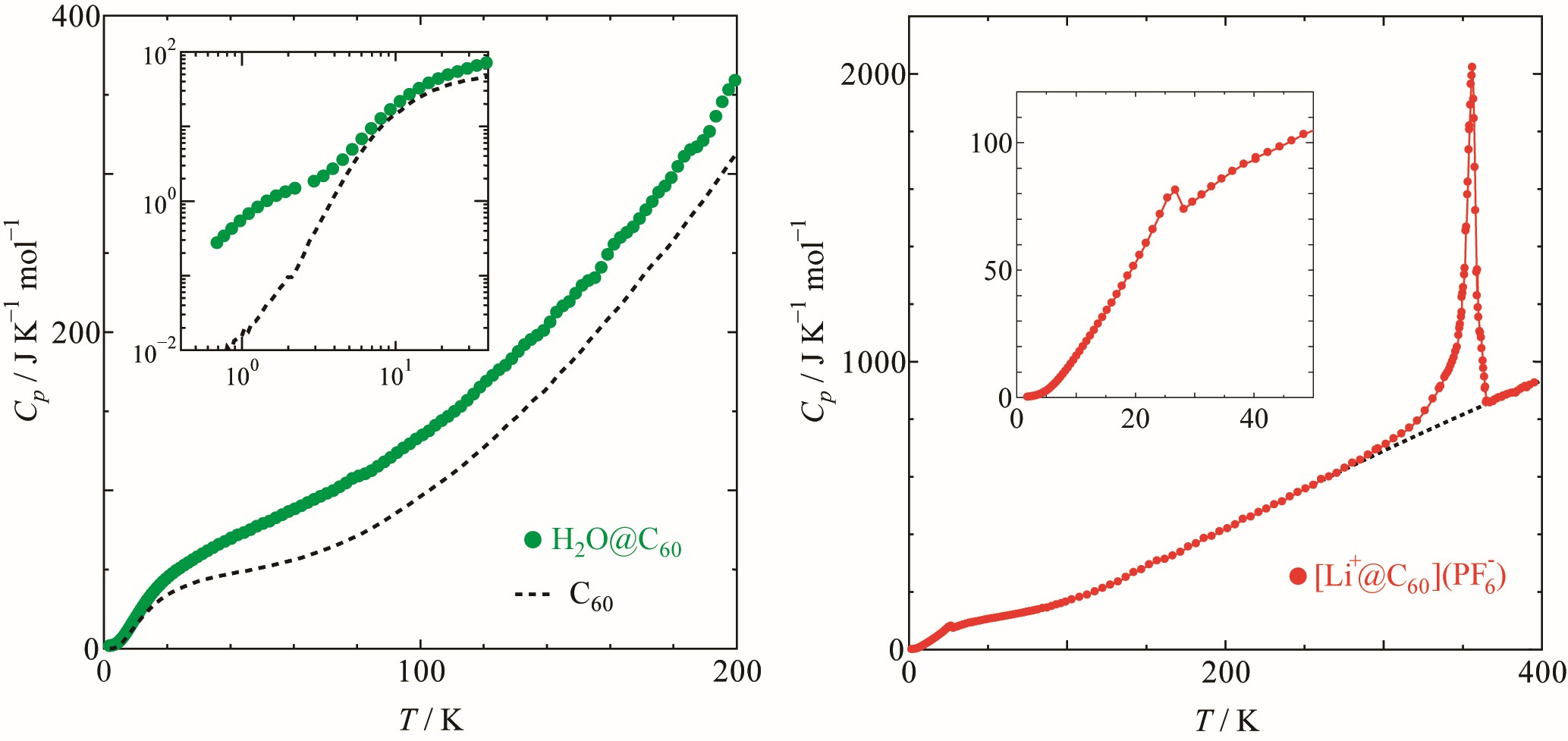
Figure 1: Temperature dependence of the heat capacity of endohedral fullerene systems.The inset focuses on the low-temperature range.
Molecules encaged in nanospace exhibit properties distinct from those in the bulk because guest-guest interactions are restricted by the host cage. When the cage is sufficiently larger than the guest molecule, the guest can undergo quantized motions even at very low temperatures. In crystalline phases, weak guest-guest interactions can also influence these quantum motions. In the classical limit, free motion is entropically favored, whereas localization driven by guest-guest or guest-host interactions is energetically favored. Therefore, as the temperature is lowered, the energetic contribution eventually overcomes the entropic contribution to the free energy, inducing an order-disorder phase transition. In the quantum limit, on the other hand, the rotor occupies the ground state of the free-rotation potential at the lowest temperatures, and no phase transition occurs. The crossover between these two regimes is the focus of our research.
Fullerene C60 is an ideal system for investigating these effects because its nearly spherical inner cage can form co-crystals with various small molecules. Recently, various endohedral fullerenes, M@C60, have been synthesized on milligram-to-gram scales, enabling experimental studies of their dynamic and thermodynamic properties. In this presentation, we show our calorimetric and spectroscopic investigations of fullerenes encapsulating Li+ and H2O.
H2O@C60 was synthesized at Kyoto University using the molecular surgery method [1]. Far-infrared spectroscopy and neutron scattering measurements have shown that the H2O molecule undergoes quantum rotation [2]. In particular, excitations of the two nuclear-spin isomers, para-H2O and ortho-H2O, were observed, demonstrating that H2O rotates freely inside the C60 cage. We measured the heat capacity of H2O@C60 between 0.6 and 200 K and confirmed that H2O undergoes nearly free rotation inside the C60 cage [3]. We also found that the ground state of ortho-H2O is split into two states, with the excitation between them appearing as a Schottky-type heat-capacity peak at approximately 1 K. Furthermore, we investigated the time dependence of this peak and found that ortho-H2O slowly converts into para-H2O, in marked contrast to H2@C60 [4].
Li+@C60 co-crystallized with PF6- was synthesized at Idea International Co., Ltd. using the plasma-shower method [5]. According to crystallographic studies, the Li+ ion is distributed over a spherical shell around the center of the C60 cage at 150 K. Below 100 K, it becomes localized at two sites, and finally at a single site below 24 K, exhibiting antiferroelectric ordering [6]. We measured the heat capacity of [Li+@C60](PF6-) between 1.8 and 395 K and found a phase-transition peak at 24 K, corresponding to the cooperative localization of Li+ at a single site [7]. However, no significant thermal anomaly associated with the localization of Li+ at two sites was observed. We also conducted terahertz-far-infrared (THz-FIR) spectroscopic measurements and observed a broad absorption band at 42 cm-1 (1.3 THz) [8]. Because this peak blue-shifted with decreasing temperature, we assigned it to an envelope of quasi-free rotational bands of the Li+ ion. Below 100 K, the peak intensity gradually decreased with decreasing temperature. We therefore assigned this band to excitations among quasi-free rotational states located above the localized ground states.
These two examples demonstrate that orientational (or positional) ordering of molecules (or ions) can occur either with or without a phase transition, depending on the delicate balance of cooperative interactions.
- [1] K. Kurotobi, Y. Murata, Science 333, 613-616 (2011).
- [2] C. Beduz, et al., Proc. Natl. Acad. Sci. U.S.A. 109, 12894 (2012).
- [3] H. Suzuki, et al., J. Phys. Chem. Lett. 10, 1306-1311 (2019).
- [4] Y. Kohama, et al., Phys. Rev. Lett. 103, 073001 (2009).
- [5] H. Okada, et al., RSC Adv. 2, 10624-10631 (2012).
- [6] S. Aoyagi, et al., Angew. Chem. Int. Ed. 51, 3377-3381 (2012).
- [7] H. Suzuki, et al., Phys. Chem. Chem. Phys. 21, 16147-16153 (2019).
- [8] H. Suzuki, et al., Phys. Chem. Chem. Phys. 8, 31384-31387 (2016).
Acknowledgements: Prof. Hal SUZUKI gratefully acknowledges to Ms. M. Ishida, Mr. K. Kawachi, Dr. Y. Kasama, Dr. C. Otani, Prof. Y. Murata, Dr. Y. Hashikawa, Prof. Y. Miyazaki, and Prof. M. Nakano for their valuable contributions to this work. This work was supported by Japan Society for the Promotion of Science (JSPS) Grant-in-Aid for Scientific Research (KAKENHI) Grants No. 15K05404 and 17K19102.