Prof. Giacomo Baldi1
Talk: "Inelastic X-ray scattering and the low frequency vibration of glasses"
1Department of Physics, Trento University, Trento, Italy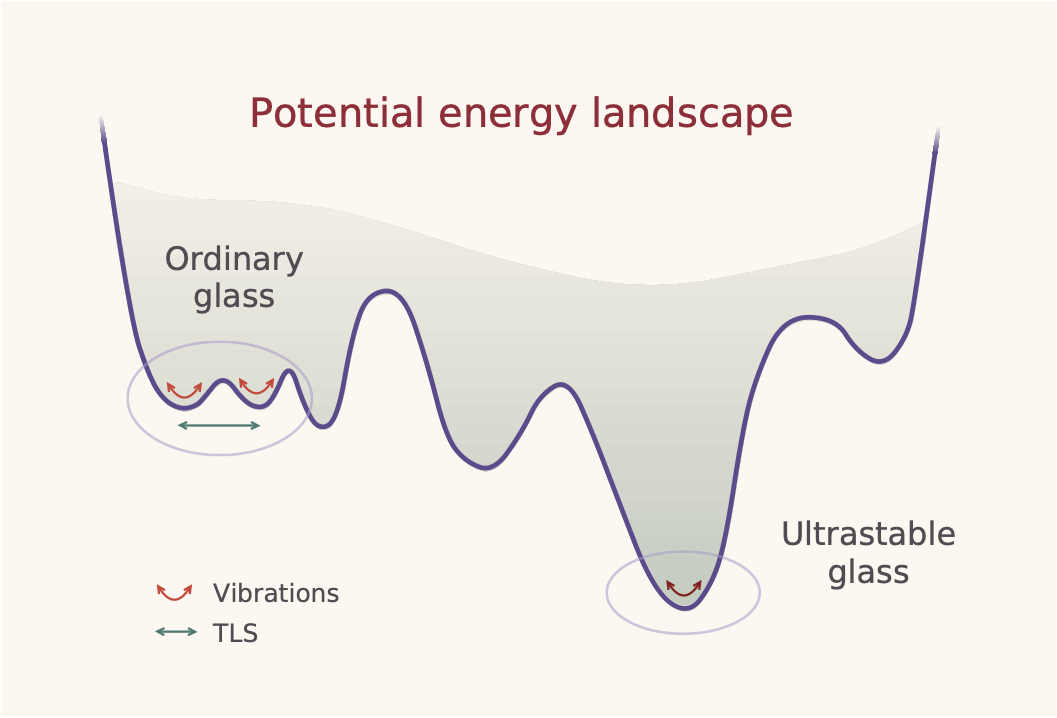
The vibrational dynamics of glasses and crystals are remarkably similar, even though their low temperature thermal properties differ significantly. Differences between the ordered and the disordered states of matter appear only in the low frequency part of the vibrational spectrum, typically at and below the terahertz range [1]. Amorphous solids exhibit an enhanced density of vibrational states at the boson peak, the presence of Rayleigh scattering of sound waves [2] and relaxation processes that remain active well below the glass transition temperature and give sizeable contributions to sound attenuation and to light, X-rays and neutron scattering cross sections in the quasi-elastic regime.
In this seminar I will briefly review the experimental results that we obtained in the last ten to fifteen years with inelastic X-ray scattering (IXS) and other synchrotron-based methods on the vibrational dynamics of glasses. I will then discuss in more details two recent experiments performed with an innovative spectrograph for nuclear resonance analysis of IXS, that allowed us to probe the density of vibrational states with the exceptional energy resolution of 0.1 meV [3,4]. The first experiment investigates the vibrations of vitreous silica in a frequency range where anharmonic and relaxational processes give sizeable contributions to the scattering cross-section. In the second experiment we probed the low frequency vibrations of an ultra-stable glass of TPD and of the corresponding conventional glass. I will discuss the relevance of quasi-localized vibrational modes in these two samples and the effect of glass stability on the low frequency vibrations.
- [1] G. Baldi, A. Fontana, and G. Monaco, Vibrational dynamics of non-crystalline solids , contributed chapter to "Low-Temperature Thermal and Vibrational Properties of Disordered Solids" (A Half-Century of universal "anomalies" of glasses), Ed. M. A. Ramos, World Scientific, pag. 177 - 226 (2022).
- [2] G. Baldi, V. M. Giordano, G. Monaco, and B. Ruta, Sound Attenuation at Terahertz Frequencies and the Boson Peak of Vitreous Silica, Phys. Rev. Lett. 104, 195501 (2010).
- [3] F. Caporaletti et al., (in preparation)
- [4] I. Festi, E. Alfinelli, D. Bessas, F. Caporaletti, A.I. Chumakov, M. Moratalla, M.A. Ramos, M. Rodríguez-López, C. Rodríguez-Tinoco, J. Rodríguez-Viejo and G. Baldi, Effect of glass stability on the low frequency vibrations of vapor deposited glasses, Phys. Rev. X 16, 021021 (2026).